ASU Leads Arizona in Producing Unicorn Founders, New Stanford Research Shows
New research from Stanford Graduate School of Business highlights the role of universities in building billion-dollar startups, with Arizona State University leading the Grand Canyon State.
By Kyle Macdonald, COO of Silicon Oasis
Arizona State University is helping put Arizona on the national map for entrepreneurial talent, according to new research from Stanford Graduate School of Business professor Ilya Strebulaev.
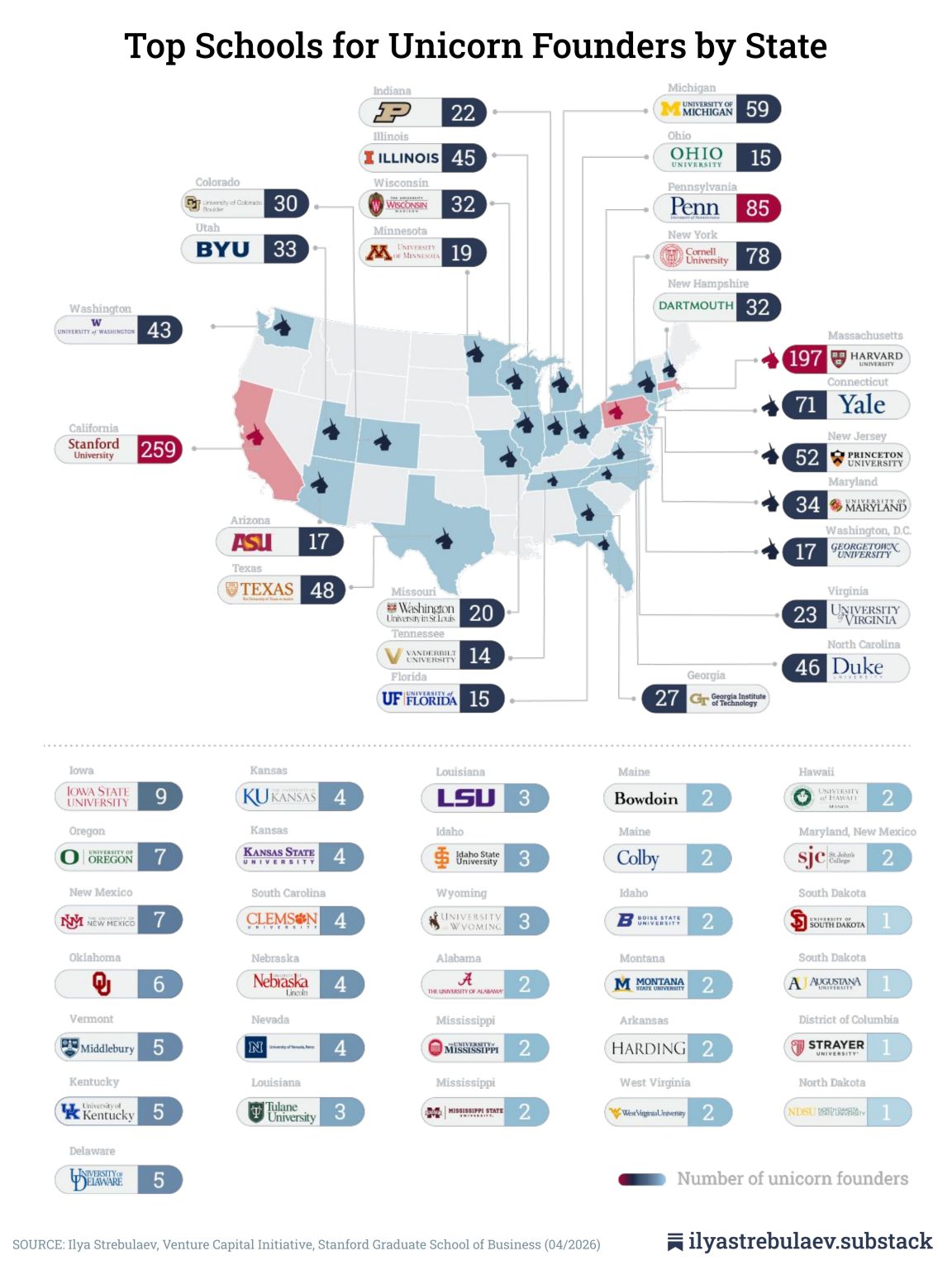
A newly released analysis from Stanford's Venture Capital Initiative identifies the university in each U.S. state associated with the greatest number of unicorn founders—entrepreneurs behind privately held startups that have reached valuations of at least $1 billion.
Arizona State University leads Arizona with 17 unicorn founders, highlighting the university's contribution to the development of high-growth entrepreneurial talent.
The findings underscore the important relationship between higher education, entrepreneurship, and the creation of globally competitive technology companies.
Public Universities Are Driving Unicorn Creation
While Stanford University and Harvard University dominate the national conversation around startup founders, the research reveals that public universities are the leading institutions in a majority of states.
Stanford leads California with 259 unicorn founders, followed by Harvard with 197 in Massachusetts. Other prominent private institutions include the University of Pennsylvania with 85, Cornell University with 78, and Yale University with 71.
However, public universities are making a substantial contribution to the nation's startup economy.
The University of Michigan leads its state with 59 unicorn founders, followed by the University of Texas at Austin with 48, the University of Illinois with 45, and the University of Washington with 43.
Other notable public institutions include the University of Maryland with 34, the University of Wisconsin with 32, the University of Colorado Boulder with 30, and Georgia Tech with 27.
These findings reinforce an increasingly important reality: billion-dollar companies are not exclusively built by graduates of elite private universities or traditional venture capital hubs.
Entrepreneurial talent is being developed throughout the country, creating opportunities for emerging technology ecosystems to compete on a national and global scale.
ASU's Role in Arizona's Startup Ecosystem
With 17 unicorn founders associated with the university, ASU stands as Arizona's leading institution in this analysis.
The university's broader innovation infrastructure includes entrepreneurship programs, startup incubation, research commercialization, and partnerships designed to connect students and researchers with industry.
Through initiatives such as the Edson Entrepreneurship + Innovation Institute and Skysong Innovations, ASU supports pathways for transforming ideas, research, and emerging technologies into commercial opportunities.
The Stanford findings provide another indication of the university's ability to develop individuals who go on to participate in building high-growth companies.
Importantly, the research measures founders' educational backgrounds, not necessarily where their companies were founded or currently operate. ASU's 17 founders should therefore not be interpreted as 17 Arizona-based unicorn companies.
That distinction also highlights a larger opportunity for Arizona: retaining more of the entrepreneurial talent developed by its universities.
Turning University Talent Into Arizona Companies
For Arizona's technology ecosystem, the findings raise an important question: How can the state ensure that more of the entrepreneurs educated here choose to build and scale their companies here?
Arizona already possesses several important ingredients for a competitive startup ecosystem, including major research universities, a growing semiconductor industry, expanding technology infrastructure, and an increasingly connected entrepreneurial community.
The next step is strengthening the pathways connecting university talent with experienced founders, investors, operators, and potential customers.
That means expanding access to early-stage capital, supporting university commercialization, developing mentorship networks, and creating more opportunities for students and graduates to engage with Arizona's startup community.
Organizations such as Silicon Oasis can play an important role by connecting these stakeholders and helping entrepreneurs access the relationships and resources necessary to build successful companies.
The opportunity extends beyond ASU. The University of Arizona, Northern Arizona University, Grand Canyon University, and Arizona's community colleges all contribute to the state's entrepreneurial and technical talent pipeline.
Building a nationally competitive technology ecosystem requires connecting these institutions with the broader innovation economy.
Arizona's Opportunity Is to Build the Next Generation of Unicorns
Stanford's research demonstrates that successful startup founders emerge from universities across the country.
For Arizona, ASU's position in the analysis is an encouraging indicator of the entrepreneurial talent already being developed within the state.
But producing successful founders is only part of the equation.
The larger opportunity is creating an environment where those founders can launch, fund, scale, and ultimately exit their companies without needing to leave Arizona.
At Silicon Oasis, our vision is to help establish Arizona as one of the nation's top five technology ecosystems.
Achieving that vision will require stronger connections between universities, entrepreneurs, investors, corporations, and community leaders.
ASU's representation in Stanford's research provides another reason to believe Arizona has the talent to compete.
The challenge—and opportunity—is ensuring that more of the next generation of billion-dollar companies are built right here.
Articles of Reference
Ilya Strebulaev — LinkedIn: Top Schools for Unicorn Founders by State
Stanford Graduate School of Business, Venture Capital Initiative — Research graphic, April 2026 (provided above).
Research note: The analysis covers U.S. unicorn companies for which founders' educational backgrounds were available. The figures reflect university affiliations rather than the location of company headquarters, and should not be interpreted as a ranking of current university startup programs.
Subscribe to the Silicon Oasis hard print magazine and our daily news brief for ongoing coverage of Arizona’s innovation and tech landscape — in print and in your inbox.
Similar Blogs
News, Voices & Impact
Explore updates, field notes, and stories that showcase our mission and impact.